2. Health and sustainable development
-
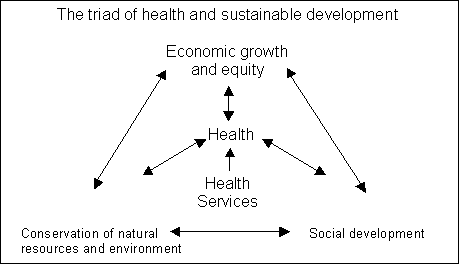
Sustainable development aims at improving the quality of life of all the world’s people without increasing the use of our natural resources beyond the earth’s carrying capacity. This requires integrated action towards economic growth and equity, conservation of natural resources and the environment, and social development. Each of these elements is mutually supportive of the others, creating an interconnected sustainable development triad.
-
Health is recognised as a key goal of sustainable development in the first principle of the Rio Declaration on Environment and Development, which states that: “Human beings are at the centre of concerns for sustainable development. They are entitled to a healthy and productive life in harmony with nature.” The extent to which sustainable development benefits a community is closely tied to its level of health, as health is a product of economic, social, political and environmental factors, as well as of health services. If our development path is not conducive to sustained improvements in health, then it is not sustainable development.
-
Health, in turn, contributes to economic, social and environmental development through multiple pathways. Improved health feeds sustainable development and sustainable development feeds improved health in a virtuous cycle, supported by effective health services.
-
The opposite is experienced by many of the world’s people: a vicious cycle of underdevelopment and ill health. The poor, marginalized, displaced and refugees carry the greatest burden of preventable and treatable disease and death. Inappropriate development and over-consumption also drive the disease burden.
-
Women, children, youth, the elderly, orphans and people with disabilities are amongst those vulnerable to disproportionate burdens of specific forms of ill-health. This holds true at all levels of development, but is most pronounced under circumstances of poverty.
-
Whole communities are often marginalized and excluded from the opportunities for sustainable development and health – be it in rural or urban areas, amongst minority groups, in the face of direct discrimination, or amongst refugees or those displaced by war or conflict. There are health consequences of social exclusion, poorer services and lack of opportunities for development and empowerment.
-
Peace, good governance, political stability and concern for its people are the foundation for the sustainable development of nations.
-
There are patterns of development that undermine health and sustainable improvements in health. These include factors related to lifestyles, consumption patterns and particular forms of economic development and inequity. Improved health is a pre-requisite for effective development. Poor health, amongst other things, undercuts improvement in gross domestic product.
-
Agenda 21, the global plan of action agreed to at the United Nations Conference on Environment and Development (UNCED) devotes an entire chapter to “Protecting and Promoting Human Health”. Chapter 6 recognises the interconnection between health and environmental, social and economic development, supports an inter-sectoral approach and identifies five programme areas: meeting primary health care needs, particularly in rural areas; control of communicable diseases; protection of vulnerable groups; meeting the urban health challenge; and reducing health risks from environmental pollution and hazards.
|