|
|
|
Critical Linkages: Livelihoods, Markets and Institutions
|
|
4. Implications for the Livelihoods Development Agenda
Our analysis of markets and institutions has important implications for the livelihoods development agenda as regards research, analysis, policy and local action.
We need to
- place our understanding of livelihoods and their development in a much more explicit context of dynamic market and institutional change;
- pay much more attention to understanding institutional arrangements and their relationships with the institutional and political environment and with technological change;
- move away from pre-occupation with neo-classical competitive markets;
- look for viable incremental changes that benefit the poor, are ‘politically’ viable, and are consistent with longer term processes of pro-poor institutional and economic development
As we have demonstrated with our discussion of the micro-finance and green revolutions, in many ways this is not to suggest anything new, it is rather a call for theory to catch up with practice.
In order to operationalise this agenda, we propose first that these issues should be made much more explicit in ‘basic’ livelihood thinking. We have suggested elsewhere how this might be incorporated into the goals and principles of formal livelihood approaches (Dorward, 2001b). For many the ‘livelihoods approach’ is encapsulated by the livelihoods framework (Carney, 1998), and this can be amended to give more explicit recognition to the importance and roles of markets, institutions and technology in livelihood development (see figure 5).
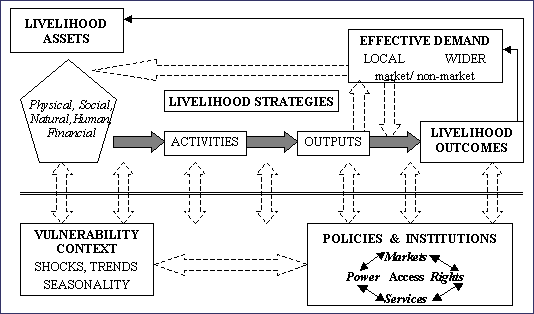
Figure 5 Modified Sustainable Livelihoods Framework9
This then has to be translated into identification of possible entry points to promote pro-poor growth. Figure 6 puts forward a conceptualisation that again attempts to integrate the interactions between institutions, markets, technology and the assets and opportunities open to people.
Footnotes:
- From Dorward, 2001b
|
|