|
|
|
Critical Linkages: Livelihoods, Markets and Institutions
|
|
3. Institutional issues in pro-poor market development
Following North, 1990 and Hall and Soskice, 2001, we define institutions as ‘rules of the game’, defining the incentives and sanctions affecting people’s behaviour. Key concepts relevant to our arguments here are the distinction between the institutional environment and institutional (or contractual) arrangements (Davis and North, 1971); the interaction of these with property rights, information flows, transaction costs, transaction risks, and market access failures for different market participants (e.g. Williamson, 1985, 1991, Dorward, 2001a); and processes whereby institutions change (North, 1990). The key point that emerges from an examination of institutional and economic development using these concepts is that less developed economies are characterised by situations with high transaction costs and risks, weak information flows, and a weak institutional environment: actors, particularly those with little power or financial and social capital, face high costs in accessing information and property rights enforcement. This inhibits access to markets and market development. This in turn inhibits economic and technological development, and low levels of economic activity themselves lead to thin markets, high transaction costs and risks, and high unit costs for infrastructural development. The result can easily be a ‘low level equilibrium trap’. We are left with critical questions about (a) the processes by which institutional, technological, social and economic development can proceed and (b) the roles of different stakeholders in promoting such development, particularly development paths that will involve and benefit the poor.
One important approach to follow in addressing this question is to consider the political economy processes of institutional change. Again North has made a seminal contribution here with a historical perspective on the influence of different paths of institutional change on economic development (North, 1990; North, 1995;Davis and North, 1971; North and Weingast, 1989). Institutional change is explained in terms of responses of powerful groups to changes in relative prices, technologies and transaction costs. These groups respond by modifying institutions in ways that they perceive to be in their interests. It is quite possible that in different countries the same sets of changes in relative prices and in transactions technology could stimulate radically different types of institutional change. Much depends upon (a) the perception by different groups of the possible opportunities and threats posed to their interests by alternative paths of institutional change or stagnation, and (b) their political effectiveness (locally, nationally and internationally) in influencing the paths and pace of institutional change. In broad terms institutional change can take an “anti-development” form (structuring transactions to create rents), or a “pro-development” (structuring transactions to reduce costs, thereby providing incentives for more trade and investment). There is a strong “path dependency” in these processes of institutional change, as development history plays an important role in determining both the relative perceptions and power of different groups on the one hand, and the institutional and technological options that they face on the other.
In addition to considering the processes of institutional change, we also need to look at the types of institutional change that may be required if economies and communities are to climb out of the ‘low level equilibrium trap’ described above. The emphasis of the current dominant policy consensus (as outlined, for example, in World Bank, 2000, 2002 and IFAD, 2001) is almost exclusively on the institutional environment (it lacks formal attention to institutional arrangements) and on the role of the government and civil society (in improving communications, property rights, the macro-economic environment, and access to information to support neo-classical competitive markets). These are, we believe, very important, but unfortunately if the institutional analysis stops there its principal output is a growing list of often unrealistic demands on governments. It becomes clear that the liberalisation agenda of the 1990s that emphasised and tried to escape the serious problems of state failure in market interventions has again run up against the buffers of serious state failure, but now these failures are in providing the institutional support required for privatised markets to develop and work in the challenging conditions where poverty is most intractable.
How can we move beyond this impasse? We suggest that the institutional analysis needs to be taken forward in a number of ways. First, we need to recognize an inherent contradiction between the broader conceptual framework emphasizing neo-classical competitive markets and an important, pragmatic thread that runs through conventional development wisdom, calls for support for bottom up non-market organisations (in producer groups, CBOs, other stakeholder groups, micro-finance groups, and common property resource management groups for example). These are not parts of a competitive market structure, but it appears that they can work: policy analysis needs to catch up with praxis, and we need to integrate them into an overall conceptual framework.
A more comprehensive conceptualization of markets as institutions (and hence part of the process of institutional development), however, overcomes these problems. Two practical policy conclusions arise from this: first that competitive neo-classical markets are then seen as only one institutional model (albeit a very important and effective one) by which resources, production and consumption are allocated, coordinated and exchanged in an economy; and second that economic development involves the development of institutional arrangements as well as of the institutional environment. These points merit further consideration.
With regard to competitive neo-classical markets being only one institutional model for allocation, coordination and exchange in an economy, this is not to deny its many advantages, and efficiency and effectiveness in performing these functions. However, the conditions under which markets are efficient are quite restrictive (requiring, for example, a well developed institutional environment for information flows, property rights enforcement, and low cost, low risk exchange of clearly defined and standard goods and services) and even in the most developed economies a very significant proportion transactions are not conducted in competitive markets but instead are conducted within firms and in long term relationships between firms (see for example Coase, 1992, Williamson, 1985, 1991, Hall and Soskice, 2001). Globally the proportion and amount of transactions occurring within firms (and therefore through non-market arrangements) is growing as two thirds of world trade is either within transnational corporations (TNCs) or associated with TNCs (United Nations, 1999 cited by Yusuf, 2001). For transactions within developing countries (with much lower densities, smaller scales of economic activity, smaller transaction sizes and a less developed infrastructural and institutional environment) these conditions are much more restrictive. Under these circumstances alternative institutional models may perform more effectively, and indeed neo-classical competitive markets may not perform at all.
Figure 2 (from Dorward et al., 1998) provides a simple representation of this view of economic development. The basic postulate is that technological and institutional development are two key, interacting and endogenous elements in economic development. Highly productive technologies require intensive and effective mechanisms for complex coordination and exchange, to allow investment in and operation of different specialized activities. These mechanisms in turn require effective institutions. Economic development is therefore shown in figure 2 as a movement from the south west to the north east, with complementary progress in institutional and technological development.
Simplistic and highly stylized though it may be, this simple representation poses a number of important and interesting questions. We limit ourselves to discussion of two. First, it helps us to conceptualise a mapping of different combinations of the two dimensions of institutional and technological development, and to ask how the exchange and coordination mechanisms for particular technologies may be provided in specific institutional contexts. Poorly developed institutions cannot support highly advanced technologies, and therefore in the south east of the diagram we encounter market failure. In the north west corner, however, high levels of institutional development should allow effective competitive markets to support relatively simple technologies. Along the south west to north east diagonal there is more ambiguity: here institutional development may be insufficient to support the competitive markets required for the coordination and exchange necessary for particular technologies. Market failure is not, however, the only alternative to well functioning competitive markets. Where institutions are not sufficiently developed to support these markets, actors will often develop other (non-competitive or non-market) arrangements for coordination and exchange, which may operate more effectively and more efficiently than liberalised competitive markets. There is, therefore, no a priori reason for expecting an optimal development path or movement from the south west to the north east to be restricted to situations with ‘all markets effective’: it is more likely to move through a mix effective and ineffective competitive markets with non-market institutional arrangements. Two immediate conclusions follow from this. First, current policy emphasis on institutional development to promote competitive markets may be sup-optimal in terms of its effectiveness in promoting economic development, and particularly in promoting economic growth for the poor, who tend to operate under conditions that present the greatest challenges to liberalized competitive markets. Second, if non-competitive and non-market forms are likely to be important and indeed desirable mechanisms for economic coordination and exchange, we need to develop a much better understanding of their operation, of the ways that they change, and hence of ways in which policy can promote pro-poor change.
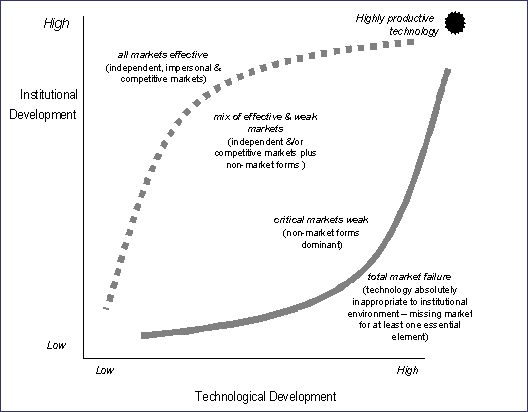
Figure 2.
Technological and Institutional Development and Market Forms
We illustrate this analysis, and the points that emerge from it, by examining two major, if often controversial, processes of change in developing countries in the last 50 years, the ‘micro-finance revolution’ and the ‘green revolution’.
The micro-finance revolution has at its root the interaction of two processes of change in the 1970s and 80s: the development of the Grameen Bank in Bangladesh (see for example Jain, 1996), and the Washington critique of development finance (see for example Von Pischke et al., 1983). Although these initially developed independently, the synergies between them soon became apparent: a particular institutional model (i.e. a set of non-market institutional arrangements) was developed to address widespread market failure in financial markets for the poor. At the same time the failings of the hitherto dominant institutional model for agricultural and rural were being increasingly recognised, in the context of growing dissatisfaction with direct government involvement in markets. The Grameen Bank and other micro-finance initiatives expanded dramatically, in their spread and in the volumes of savings and loans that they handled. The achievements of the micro-finance revolution remain the subject of much debate, in particular its ability to reach the poorest and the dangers of over-crowding and competition between micro-finance suppliers. However, the point that we would like to make here is that it has resulted in improved access of many poorer people to financial services, and that this has been achieved by complementary change in the institutional environment, in institutional arrangements, and in technology.
This is illustrated in figure 3, which extends von Pischke’s concept of the financial frontier (Von Pischke, 1993) to loosely consider the ways that population density, economic activity and wealth affect households’ access to financial services, in the context of people’s concerns with livelihood strategies that involve pathways and transitions from one set of activities to another. Figure 3 suggests, in a highly stylised way, (a) a range of possible livelihoods that people may engage in in local economies with different densities of economic activity; (b) ‘livelihood development pathways’ by which they may seek to improve their lot as economic growth occurs, (c) the relationship of livelihood strategies and density of economic activities with the ‘frontier’ of access to formal financial markets, and (c) the contribution of micro-finance in shifting that frontier to extend access to financial services for poorer people in areas with moderate densities of economic activity. Thus the figure suggests, in a very broad and illustrative way, how as we consider situations with lower rather than greater density of economic activity and people with lower rather than higher relative household wealth, the financial frontier rises, with a decline in access. Many MFIs have been highly successful in shifting the financial frontier downwards to allow access to formal financial services by households with lower wealth in areas of higher economic density. Our argument here is that successes of MFIs have been achieved by (a) a change in the institutional environment that both permitted NGOs to engage in these activities and enabled them to access soft development finance to on-lend; and (b) new institutional arrangements linking borrowers, groups and micro-finance providers in ways that reduced transaction costs and risks in the provision of external finance to rural people.
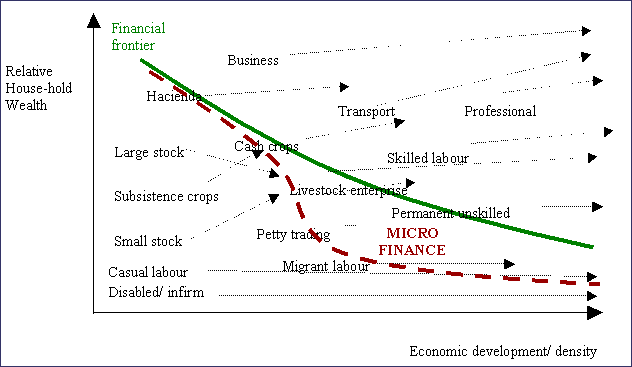
Figure 3: Micro-Finance and the Financial Frontier
With time micro-finance developments have led to, and been stimulated by, further changes in the institutional environment, in institutional arrangements, and in technology. Changes in the institutional environment have included, for example, new financial regulations bringing micro-finance activities into main stream financial markets, with greater access to commercial finance, greater protection for micro-finance clients, and opportunities for micro-finance organisations to offer a greater range of financial services. New institutional arrangements have been developed as the micro-finance concept has spread to different areas and agencies have developed mechanisms to match the needs of different clients. Changes in technology have involved (at the ‘soft end’) the development of new products and increasing use of new information and communications technologies. The challenge now is to either develop institutional arrangements and financial products that shift the frontier down in (poor rural) areas with lower density of economic activity, or to find other, sustainable, ways of shifting the frontier down, recognising the potential for longer term benefits of such a shift in increasing the density of economic activity, or the possibility of cross subsidisation with wider benefits
This is related to wider processes of economic and population growth and institutional change affecting (among other things) market development, access to markets, and asset accumulation. The ability of people to move from one set of livelihood activities to another also involves ‘exits’ from particular asset portfolios and ‘entries’ to another. Markets may play a key role in allowing such exits and entries on more rather than less favourable terms. The creative development of non-market institutional arrangements has therefore been a key component in the micro-finance revolution, in conjunction with changes in the institutional environment and in technology.
Turning now to examine the Green Revolution, Dorward et al., 2002 examine irrigated and non-irrigated agricultural transformations in the 20th century and argue that ‘there are certain necessary conditions for intensive cereal based transformations to occur: appropriate and high yielding agricultural technologies; local markets offering stable output prices that provide reasonable returns to investment in ‘improved’ technologies; seasonal finance for purchased inputs; reasonably secure and equitable access to land, with attractive returns for operators (whether tenants or land owners); and infrastructure to support input, output and financial markets.’ (Dorward et al., 2002, p20). The key question is then how these conditions can develop, and they put forward evidence that external (government) action played a role in this in almost every case. With regard to development of finance, input and produce markets, this involved the establishment of specific institutional arrangements, not liberalised competitive markets, in a process summarised in figure 4.
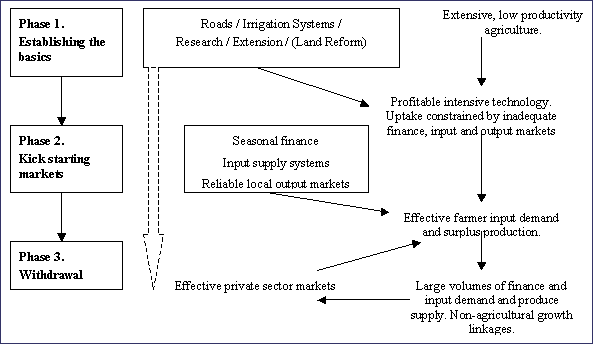
Figure 4 Policy phases to support agricultural transformation in favoured areas7
Figure 4 shows schematically how in successful Green Revolutions non market institutional arrangements may have supported financial, input and output market development in a particular development ‘phase’. Thus a prior phase (Phase I) involved basic interventions to establish conditions for productive intensive cereal technologies. Once these were in place uptake was limited to a small number of farmers with access to seasonal finance and markets. Agricultural transformation was then ‘kick started’ by government interventions (in phase 2) to enable farmers to access seasonal finance and seasonal input and output markets at low cost and low risk. Subsidies were required primarily to cover transaction costs, not to adjust basic prices. Once farmers became used to the new technologies and when volumes of credit and input demand and of produce supply built up, transaction costs per unit fell, and were also reduced by growing volumes of non-farm activity arising from growth linkages. Governments could (and should) have then withdrawn from these market activities and let the private sector take over (phase 3), transferring attention to supporting conditions to promote development of the non-farm rural economy. Difficulties arose in managing these interventions effectively and efficiently and from political pressures to include price subsidies with transaction cost subsidies and to continue with these market interventions and subsidies when they were no longer necessary (and were indeed harmful). Furthermore, the deadweight costs of such interventions will have been high if they were introduced too early, or continued too long. On the other hand, since their benefits only applied during a critical but short period in the initial transformation, these benefits have been easily overlooked by analysts. This may be one of the causes of their neglect in current conventional policy, which attempts (in our view unrealistically and mistakenly) to move straight from phase 1 to phase 3.
The point we want to make here is not to argue that the same institutional arrangements should be replicated elsewhere, nor that the particular way that the state became involved did not often become ineffective and a monumental waste of resources. The important point that emerges from this is that non-market institutional arrangements played a key role in the Green Revolution8. Efforts to promote an agricultural transformation to support improved livelihoods for people living in today’s poor rural areas are likely to face much greater difficulties than those that were faced in the successful green revolution areas of the 20th century (Dorward et al., 2002). The need for appropriate institutional arrangements to support agricultural growth is therefore that much greater today.
Footnotes:
- From Dorward et al., 2002
- This is not the place to discuss the positive and negative aspects of the Green Revolution, but its use as an illustration is based on a view that it has played a major role in poverty reduction and pro-poor economic growth in Asia, while recognising that it has not solved the problem of poverty and that there are serious questions about its environmental and social impacts (for example see Rosegrant and Hazell 2000 and Lipton and Longhurst, 1989).
|
|