|
|
|
Critical Linkages: Livelihoods, Markets and Institutions
|
|
2. Market opportunities and constraints in livelihood development
A useful question to open up this topic is to ask what market and private sector thinking have to say about sustainable livelihoods and poverty reduction. This has to be related to wider dynamic processes of growth in local and national economies, to the two-edged sword of competition (both a force for increasing economic efficiency with lower prices for consumers, and a threat to particular stakeholders, poor and non-poor), to markets (their roles, their nature, the characteristics of pro-poor markets, the importance of, for example, labour markets), to institutions supporting markets and other means of exchange and coordination, and to the dynamics of livelihood change and of relations between the livelihoods of different poor and non-poor stakeholders. Perhaps the most important point is that development of livelihoods critically depends upon, among other things, demand for the outputs (goods and services) supplied by those livelihoods.
Many of these issues are easily overlooked in livelihood approaches that (usefully) focus on the more immediate situations, opportunities and constraints facing particular groups of poor people. Such analysis can easily overlook the dynamic opportunities and constraints posed by wider market interactions. An important illustration of the importance of these issues is the on-going debate about non-farm diversification in rural livelihoods.
The growing extent and importance of rural livelihood diversification out of farming is increasingly recognised: typical observations in Africa are that
- the less poor often have more effectively diversified incomes and
- the poor tend to be stuck either in low return farm activities or in low return non-farm activities (with difficulties in agriculture pushing them into the latter).
Taken at face value these observations can lead to simplistic policy responses to expand opportunities for higher return non-farm enterprises. However, more nuanced analysis of the dynamics of livelihood and economic development and of market access tends to show that
- many non-farm activities are dependent directly or indirectly on agriculture, and
- the poor often lack access to higher return non-farm activities through lack of financial, social and human capital (see for example Barrett, Reardon, et al., 2001, Reardon et al., 2000).
Policies that ignore agricultural growth and that support higher return non-farm enterprises without addressing the factors constraining the access of the poor to these opportunities may then end up helping the better off more than the poor.
With regard to the first of these two points, a long-standing theoretical and empirical literature has examined the linkages between different activities within rural economies (for recent reviews see for example (Delgado et al., 1998, and Dorward et al., 2001). Examination of linkages allows exploration of the effects of exogenous change as they work through different elements of the rural economy.
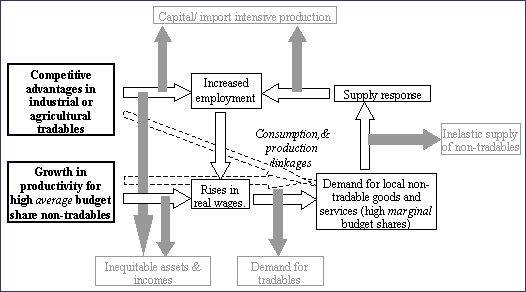
Figure 1. Linkages and leakages in a local economy
Figure 1 summarises the key linkages between processes of livelihood change and market access on the one hand and on the other wider processes of growth and a ‘virtuous cycle’ whereby production and consumption linkages allow the stimulus of some production or market opportunity to feedback into increased demand for labour and for locally produced goods and services3. However, the ‘leakages’ from this virtuous circle also need to be recognised. Understanding of these linkages and leakages may help in understanding the markets and activities that will have wider positive impacts on the livelihoods of the poor and on the opportunities available to them4. An important conclusion from the linkage literature is that the effects of particular changes on a rural economy and on poor people within it depend crucially upon the nature of the change, on the structure of the local economy, and on different poor peoples’ places within it. Regard must be given to the local demand characteristics of goods affected by price or productivity change (their average and marginal budget shares for different income groups), tradability, and local production characteristics (supply elasticities, labour and tradable input demand, upstream and downstream linkages) as well as the operation of factor markets that affect both elasticity of supply and the distribution of income within the rural economy.
An appreciation of linkages within local and national economies allows us then to examine how growth in the farm and non-farm sectors compares with regard to their supply, demand and linkage characteristics and hence their likely poverty reducing benefits? There are unlikely to be many tradable non-farm activities apart from mining that offer broadly based employment opportunities in the poorest (relatively low income and isolated) rural areas5. Only as links with urban areas develop will opportunities for non-farm tradable activities develop, but these will often be ‘high barrier to entry’ activities, limiting the benefits to the poor (Barrett et al., 2000). Farm activities, on the other hand, are more likely to offer opportunities for broadly based expansion in tradable activities (whether cash crops or tradable food crops), with direct and indirect employment and income opportunities for the poor, again depending upon barriers to entry associated with, for example, the nature of the crop, marketing systems, access to land, etc.. Even here the poor are unlikely to gain much directly as self-employed producers of tradable agricultural commodities, with limited access to land and capital and relatively low on-farm incomes. However, there is often considerable potential for them to benefit directly (from increased labour demand from significant numbers of less poor farmers producing tradables) and indirectly (through increased demand for non-tradables from these farmers). The challenge is then to improve the access of less poor farmers to the skills, capital, inputs and output markets to allow them to respond to opportunities in production of farm tradables, and to improve access by the poor to linkage benefits.
Growth and poverty reduction through increased productivity of non-tradables will be effective as a basic source of poverty reducing growth where the non-tradable is widely consumed (i.e. has a high average budget share), either by the poor themselves or by a large non-poor population (with consumption linkage benefits for the poor) High average budget shares for food crops in rural areas in Africa (Delgado et al., 1998) suggest that farm activities are more likely to meet these criteria than non-farm activities. Growth and poverty reduction through increased productivity of non-farm non-tradables with high marginal budget shares is more likely to be important as a secondary growth process, supporting consumption linkages. Institutional or technological change in non-tradable production may also have important redistributive effects by bringing down barriers to entry for poor producers and allowing them to gain market and income shares from less poor producers, as well as lowering prices to poor consumers.
These arguments are summarised in Table 1. A broad conclusion, to which there will be significant exceptions, is that in many poorer rural areas increasing productivity of farm activities will have greater potential for stimulating poverty reducing growth. Increased productivity of non-farm activities is likely to have greater poverty reducing benefits in supporting secondary, linkage dependent poverty reducing growth, again particularly if the activities have low barriers to entry and high labour demands. It can be further argued, from historical experience and from examination of the linkage and budget share characteristics of different types of agricultural production, that within agriculture, intensive cereal based growth offers the best prospects for sustained poverty reducing growth (see for example Dorward and Morrison, 2000)6.
| |
Tradable |
Non tradable |
| Farm activities |
Direct gains if high labour content by poor producers or large upstream / downstream linkages have high labour content by poor producers |
Direct gains if high average budget share for poor consumers |
| Indirect gains if high average budget share for non-poor consumers and the poor benefit from expenditure linkages |
| Indirect gains if high labour content by the non-poor and the poor benefit from expenditure linkages |
Potentially important gains from expenditure linkages for activities with high elasticity of supply and low barriers to entry and producing goods and services with high marginal budget shares (e.g. horticulture, livestock) |
| Non farm activities |
Apart from mining, other NR activities and migrant labour/ remittances, unlikely without good communications and strong urban or export markets, features generally absent from poorer rural areas. |
Limited direct or indirect gains as unlikely to have high average budget shares for poor or less poor consumers in poorer rural areas |
| Potentially important gains from expenditure linkages for activities with elasticity of supply and low barriers to entry producing goods and services with high marginal budget shares (e.g. services) |
The operation, extent and terms of access to different markets are then critical questions, which are rightly, being given attention in on-going studies of rural diversification (for example in the LADDER project). What we are arguing here is that these issues need to be given much more prominence in our ‘basic’ conceptualisations of livelihoods. We propose later in the paper ways in which this may be achieved, but turn now to examine the question that immediately follows if we accept the importance of market development: how can pro-poor markets be developed? Here we need to consider the role of institutions, entering what, in the DFID framework, is sometimes considered the ‘black box’ of PIPs (Policies, Institutions and Processes).
Footnotes:
- A critical distinction is made between tradable and non-tradable goods and services, tradable goods and services being those that may be imported or exported to or from the area. In practice the distinction between tradables and non-tradables is often not distinct, varying with (a) the scale or the boundaries of an area (the larger the area the greater the proportion of non-tradables), (b) its accessibility (the less accessible the greater the proportion of non-tradables) and (c) the comparative production costs inside and outside the area. These factors together determine the relationship between local costs on the one hand and the spread between ‘import’ and ‘export’ parity prices on the other. Although these terms are often associated with international trade, they are equally applicable to intranational trade between different districts or between rural and urban areas.
- DFID, 2001 draw a distinction between markets that the poor participate in directly and markets that they benefit from indirectly as a result of such markets contributing to wider pro-poor economic growth.
- See Wiggins, 2001 for a fuller discussion of these issues. Tourism and crafts may also offer opportunities for non-farm tradable activities, but, as with mining, areas with these opportunities are likely to be the exception rather than the rule. Migrant labour and remittances may also be considered a form of tradable, exporting labour to bring extra income into an area.
- The importance of oilseeds in India’s second (rainfed) green revolution (Smith, L. and Urey, 2002) challenges the argument that intensive cereal based transformations have historically provided the most sustainable and pro-poor pattern of growth. However in the Indian context oilseed crops may have many characteristics of cereals as regards their linkages within a large domestic market, and oilseed growth has been associated with growth in cereals. This is a topic that needs further examination.
|
|