| 6. Impact on Human Development Indicators |
| |
|
The dire predictions of the early 1990s about the impacts of HIV/AIDS on human development are now becoming reality. Evidence from southern Africa shows increasing numbers of orphans, plummeting life expectancies and overburdened health services. These impacts are undermining the gains of the last few decades and threaten to destabilise already fragile political systems.
|
| |
|
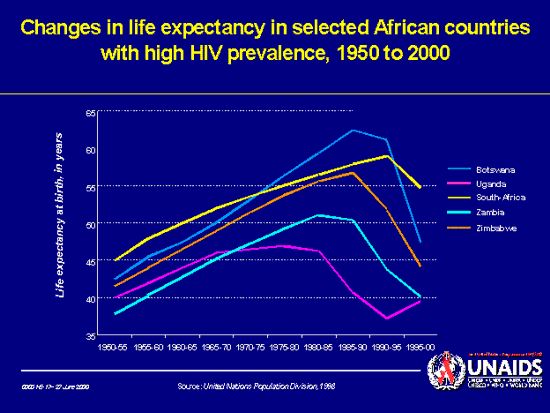
Statistics from three African countries show that under-5 mortality rates continued to drop until around 1986 at which stage they all started to rise. This has been attributed to HIV/AIDS. The data for adult deaths is even more stark and HIV/AIDS is now the leading cause of death in sub-Saharan Africa. Figure 3 shows how life expectancies in 5 African countries dropped precipitously with the advent of the HIV/AIDS epidemic after decades of steady improvement.
|
| |
|
Figure 3: Changes in life expectancy in selected African countries with high HIV prevalence, 1950 - 2000
|
| |
|
| |
|
Perhaps the most startling data come from UNAIDS models which predict that in a country where 15% or more adults are infected with HIV, at least 35% of all boys now aged 15 will die of AIDS. For a country such as Botswana, up to 50% of current 15 year olds can be expected to die of AIDS. Even if prevention efforts are successful and cut the new infection rate by half, a substantial proportion of youth will still die of AIDS.
|
| |
|
The fact that AIDS tends to kill adults in mid-life when many have started families and are economically productive, means that the impact of the disease are more profound than if it killed only the very young or elderly. An AIDS death in a family, particularly poor families, almost inevitably results in a drop in household income, lower consumption levels and decreased savings.
|
| |
|
The escalating numbers of AIDS orphans (South Africa: 420 000, Zimbabwe: 900 000, Malawi: 390 000) are severely straining the capacity of families and communities to support them. A UNICEF/UNAIDS report claims that because of the stigma and discrimination surrounding HIV/AIDS, AIDS orphans are at greater risk of malnutrition, illness, abuse and sexual exploitation than other orphans. Studies in Uganda have shown that, following the death of one or both parents, the chances of the orphans going to school is halved and those who go to school spend less time there than they did formerly.
|
| |
|
Whilst HIV/AIDS impacts across society, from the individual to the global economy, there is general agreement that it is the household that typically bears the brunt of the human and economic costs. Individual companies can, with appropriate planning, shield themselves from some of the impacts but families, particularly poor ones, have few such opportunities.
|