| 4. The interaction of poverty and HIV/AIDS |
| |
|
The interactions of HIV/AIDS and poverty are myriad, complex and not fully understood. However, in order to develop public policies and implement effective interventions, it is important that the channels through which the epidemic impacts on the economy and poverty (loss of productivity, savings, demand patterns, etc) are understood, evaluated and addressed.
|
| |
|
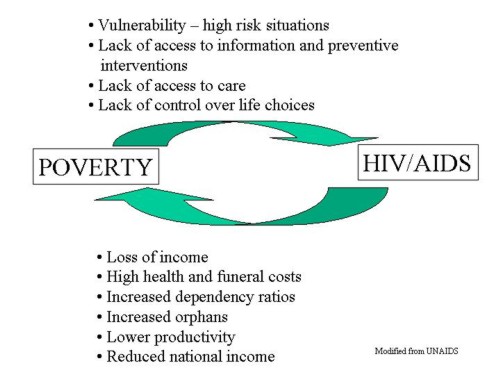
The connection between poverty and HIV/AIDS works in two directions. Firstly, and perhaps conceptually more easily understood and easier to prove, is that a case of HIV/AIDS in a household can induce and deepen poverty. Figure 2 outlines in simple terms this relationship. The infected individual goes from being a (potentially) productive person to someone requiring health care, terminal care and eventually funeral costs.
|
| |
|
Figure 2: The relationship between poverty and HIV/AIDS
|
|
| |
|
In a study conducted in the urban areas of Cote d'Ivoire it was shown that a case of AIDS in a family resulted in a halving on the outlay for school education, a drop in food consumption by 41% per capita and a quadrupling of expenditure on health care.
|
| |
|
Although HIV prevalence levels are often lower in rural areas, the impact of HIV/AIDS is still felt in these communities. It is common practice that when family members in urban areas fall ill, they return to rural homes to be cared for by their families which both increases the consumption of scarce resources and increases the risk of transmission of HIV to a spouse or others. A case of AIDS in a rural family practicing subsistence agriculture can be devastating. As the farmer becomes progressively sicker, he and the family members looking after him spend less time tending and marketing crops. A decreased income from farming coinciding with escalating health care costs compound the problem. A study in Tanzania found that a woman with a sick husband spends 60% less time on agricultural activities than she would normally do.
|
| |
|
A number of studies in West Africa have also shown that a case of AIDS in a family results in a reduced cultivation of cash crops and food products. In Namibia, the Food and Agriculture Organisation (FAO) concluded that the impact of AIDS on livestock was considerable and that households headed by women or children generally lost their cattle. In Zimbabwe the output of communal agriculture has fallen by 50% over the last 5 years and this has been blamed largely on HIV/AIDS. A local AIDs NGO has warned that a food crisis could occur in Zimbabwe as areas under cultivation continue to diminish.
|