| 11. Malaria |
| |
|
The health status of communities in the southern African region is considered to be amongst the poorest in the world, a situation exacerbated by war, famine, drought, dislocation, economic recession and political instability (Beattie and Rispel 1993).
|
| |
|
Malaria is endemic to all the southern African countries, with the exception of Lesotho, and are not exempt from the potential ravages of the disease with its debilitating effects on communities and development. Malaria directly affects economic growth and this was clearly shown by the gross national product being the lowest in countries without malaria control programmes (Wernsdorfer and Wernsdorfer 1988). The effects on communities are through increased morbidity, associated with decreased productivity and through mortality and the associated economic and social effects.
|
| |
|
Three species of Plasmodium are found in southern Africa: P. falciparum, P. ovale and P. malariae. As elsewhere in Africa, P. falciparum is by far the most common and the major agent of disease. Mosquitoes of the Anopheles gambiae and the Anopheles funestus groups of species are responsible for transmission.
|
| |
|
Malaria transmission is distinctly seasonal in southern Africa with notifications generally increasing from November onwards. Peak rates in health facility malaria outpatients usually occur in April and decline by June. There is significant inter-annual variation in both the annual malaria case totals and in the timing of malaria transmission. Malaria seasons vary in the distribution of cases across the season, this seasonal profile determines when resources need to be available, when control measures need to be in place and has implications for tourism with regard to high-risk periods and prophylactic use.
|
| |
|
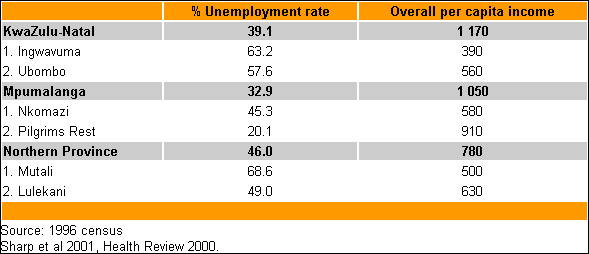
The recurrent theme that malaria is associated with poverty, certainly appears to be true for South Africa: Table 1 shows the approximate per-capita income of the three malarious provinces, and of the two districts in each with 1. the highest and 2. the second-highest malaria incidence respectively. The relationship between malaria and its socio-economic impacts and causes is of great importance and needs further investigation.
|
| |
|
Table 1: Unemployment rate and approximate per capita income in 1996 of the three malarious provinces and the two magisterial districts in each experiencing the highest malaria incidence rates.
|
| |
|
| |
|
All countries in the region have malaria control programmes in place with
the major measures being insecticide control of malaria vectors, personal
protection and malaria case management and control. Despite these measures
there has been a general upsurge in malaria in the region since the mid
1980's.
|
| |
|
There are a number of constraints on malaria control and a number of factors
exacerbating disease transmission in the region. These include:
|
| |
Drug resistance
Probably the most exacerbating problem to malaria control in southern Africa
is the resistance Plasmodium falciparum develops to anti?malarial drugs.
Patients with resistant strains remain infectious longer than patients with
sensitive strains, thereby accelerating the spread of resistance and
increasing transmission. Chloroquine resistance was first reported in Africa
from both Kenya and Tanzania in 1979 and is now documented as occurring
in all the southern African countries. Most countries have instituted the
use of Sulphadoxine/pyrimethamine (SP)as first or second line treatment.
Studies in KwaZulu-Natal Province in 2000 found in excess of 62% failure
following treatment with SP, a situation which demanded a drug policy change
(Bredenkamp et al 2001), a drug combination including artemesinin is now in
use.
|
| |
Insecticide Resistance
Pyrethroids resistant Anopheles funestus have recently been re-discovered
in both KwaZulu-Natal and southern Mozambique (Hargreaves et al 2001, LSDI,
RMCC, unpublished data). This has serious implications for the future control
of malaria vectors. Studies are currently in place in all the southern African
countries to ascertain vector insecticide resistance status.
|
| |
HIV/AIDS
Recent studies have shown a relationship between HIV/AIDS status and malaria
parasitaemia and the severity of clinical symptoms. HIV/AIDS prevalence has
steadily increased in the region and this may well be one of the underlying
reasons for the increases seen in malaria.
|
| |
Regional co-operation
Historically health has been viewed from a country specific and not a
regional perspective, this is underlined by the WHO activity in the region
which has been primarily country?based, the fact that the Southern African
Development Co?ordination Conference (SADCC) did not have a commission
devoted to health and most international funding agencies only dealt with
individual countries.
|
| |
|
Regional collaboration in regard to strategies for malaria control are
under discussion by the SADC health desk and a regional project the Lubombo
Spatial Development Initiative (LSDI), an initiative aimed at accelerated
development of the North-Eastern region of KwaZulu-Natal, southern
Mozambique and eastern Swaziland, is currently funded for year one by
the Business Trust with partially funding for the next three years by
the Government (Sharp and le Sueur 1997).
|
| |
|
Recognition of the magnitude of the malaria problem within Africa has
risen in the 1990's. In June 1997, African Heads of States and Governments
declared their commitment to strengthening malaria control in Africa; in
May 1998 the African Initiative for Malaria Control (AIM) was adopted by
African Ministers of Health at the 52nd World Health Assembly; and, most
recently at the Abuja African Heads of States Meeting on Malaria and there
is a strong commitment to tackle the malaria problem.
|
| |
|
Collaboration within the region has been enhanced by the increased
political commitment to combating the malaria problem within the region.
A task force on malaria was set up by the SADC Health Ministers to
encourage inter-country collaboration.
|
| |
|
A regional malaria collaborative project, which aims to control malaria
in southern Mozambique and thereby boost development, is an important
move towards alleviating poverty and unemployment in some of these areas.
Early survey data showed infection rates as high as 90% in children aged
2 to <15 years of age in the Mozambique sector and in close proximity to
the highest risk areas in Ingwavuma district (LSDI, Regional Malaria
Control Commission, 2000, unpublished data). These data illustrate that
malaria control cannot be viewed as a country specific problem, but is
best viewed in a regional context. The high level of support for a more
regional approach to malaria, as evidenced by support from the heads of
state in South Africa, Swaziland and Mozambique and the SADC Health
Ministers, is encouraging.
|
| |
|
We believe it is only through appropriate research, training and information
exchange that malaria control will be sustainable in southern Africa.
A high percentage of South Africa's malaria cases are classified as
imported into the country and irrespective of where drug resistance develops,
it spreads, we are not an island, but part of the southern African malaria
problem. Our highest risk malaria transmission areas are international
border districts. Malaria is not a country specific problem and we believe
that collaboration, information and expertise exchange is vital to the
future control of the disease in the region.
|